Samuel Johnson · Lives of the English Poets (1779–81)
The Scriptorium keeps the old words of English — insults, oaths and everyday words that fell out of use — each one checked against the historical dictionaries and dated to the earliest record we could confirm, with every source listed.
And the ones shared as older than they are hang in a room of their own: Younger Than They Look.
Every word hung like a painting — its wing, the year of its earliest record, and a heart to keep it on your board.
Medieval · insult
Churl.
First recorded before 1100
In Old English a 'ceorl' was simply a free man of the lowest rank, a peasant. By 1300 it meant a bondman or a fellow of low birth or rude manners, and today it means a rude, surly or stingy person.
Medieval · word
Forsooth.
First recorded before 1100
'In truth, indeed' — from 'for' plus 'sooth' (truth). By about 1600 it already sounded affected, and it came to be used sarcastically to show contempt or doubt; today it mostly signals mock-archaic speech.
Medieval · insult
Knave.
First recorded before 1100
At first simply 'boy' or 'male servant'. By about 1200 it had slid, via 'menial' and 'low-born fellow', into 'rogue, rascal' — a tricky, dishonest man. Since the 1560s it has also named the jack in a pack of cards.
Medieval · insult
Scold.
First recorded mid-1100s
In the 1100s a scold was a person of ribald, abusive speech; by about 1300, someone fond of chiding and abusive language, especially a quarrelsome woman. English law even had the offence of being a 'common scold'. Probably from Old Norse 'skald', poet — Norse poets were feared for mocking verse.
Medieval · word
Fie.
First recorded late 1200s
An exclamation of disgust, disapproval or reproach — 'shame!' or 'ugh!'. Probably from Old French 'fi', reinforced by a Scandinavian form; a natural sound of disgust found in many languages.
Medieval · insult
Caitiff.
First recorded c. 1300
A base, cowardly or despicable person; a wretch. It comes from the same Latin word as 'captive' (captivus): the sense slid from 'prisoner' to 'miserable wretch' to 'villain'.
Medieval · word
Gramercy.
First recorded c. 1300
'Great thanks!' — from Old French 'grant merci'. First an exclamation of thanks, later also of surprise. Modern French 'merci' is a shortening of the same phrase.
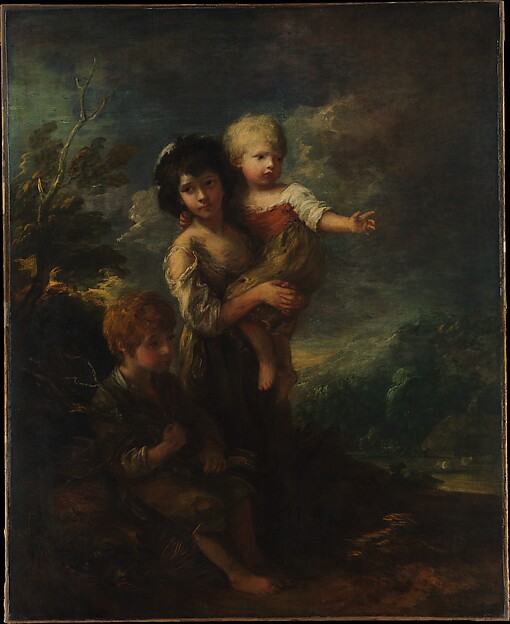
Shown: Cottage Children (The Wood Gatherers) — Thomas Gainsborough, 1787 · The Met, public domain
Medieval · insult
Ragamuffin.
First recorded 1344
Medieval · insult
Lubber.
First recorded mid-1300s
A large, slow, awkward man who would rather idle than work. From the 1500s it became mainly a sailors' word for someone inept or new at sea — hence 'landlubber'.
Medieval · oath
Marry.
First recorded mid-1300s
An oath 'by Mary', the Virgin Mary's name worn down by constant use. It could mean 'indeed!' or 'truly!', add emphasis, or express surprise; by Shakespeare's day it was a very common interjection.
Medieval · insult
Japer.
First recorded 1362
At first a trickster, deceiver or impostor; soon also one who japes — a joker, buffoon or professional jester. Medieval moralists counted 'japers' as sinners who made people laugh at idle mockery. Obsolete after the 1500s, then revived in the 1800s for a jester.
Medieval · insult
Lorel.
First recorded 1362
A worthless person, rogue or blackguard — a twin of 'losel', formed from 'loren', the other old past participle of 'to lose'. In the 1500s it was often played off against 'lord' (the lorel versus the lord).
Medieval · insult
Losel.
First recorded 1362
A worthless, good-for-nothing person; a scoundrel or wastrel. Built from 'losen', an old past participle of the verb 'to lose', so the root idea is 'one who is lost' — a ne'er-do-well.
Medieval · insult
Cumberworld.
First recorded late 1300s
A person (or thing) that merely encumbers the world — useless, taking up space. Chaucer's Troilus uses it of himself in despair.
Medieval · insult
Milksop.
First recorded late 1300s
A weak, spineless, timid man. Literally a piece of bread soaked in milk — soft food for infants — so the insult calls a grown man babyishly soft.
Medieval · insult
Sluggard.
First recorded late 1300s
A habitually lazy person — in the Middle Ages, one afflicted with the deadly sin of sloth. Formed from Middle English 'sluggi' (sluggish) plus the scornful ending '-ard'.
Medieval · insult
Doddypoll.
First recorded c. 1400
A stupid person, a blockhead. The second half is 'poll', the old word for 'head'; the first is probably Middle English 'dote', a fool or senile old man — so roughly 'dotard-head'.
Medieval · insult
Flibbertigibbet.
First recorded before 1450
A chattering gossip; a flighty, frivolous person. It probably imitates the sound of meaningless fast talk. Around 1600 it was also the name of a devil — Shakespeare's Edgar calls 'the foul fiend Flibbertigibbet' in King Lear.
Medieval · insult
Jackanapes.
First recorded 1450
Its earliest recorded use (1450) is a mocking nickname for the Duke of Suffolk (whose badge was an ape's clog and chain); it was probably already a pet name for a tame ape, which is recorded from 1522. By the mid-1500s it meant a pert, conceited, ape-like upstart, and later, playfully, a cheeky child.
Medieval · word
Tush.
First recorded mid-1400s
An exclamation of impatient rebuke or scornful dismissal — roughly 'pooh!' or 'nonsense!'. Related to 'tut'.
Medieval · insult
Varlet.
First recorded mid-1400s
Originally a young attendant or servant, especially a knight's page (it is a doublet of 'valet'). Because servants were low in rank, by the 1540s it had become an insult: a low fellow, a rogue or rascal.
Tudor & Stuart · insult
Dandiprat.
First recorded c. 1520 (as a coin)
Originally the name of a small 16th-century English coin (valued at three halfpence (Green's), though some dictionaries say about twopence); by 1556 it is also recorded for a little or insignificant person: a small boy, a dwarf, or a contemptible fellow (how the senses are connected is uncertain).
Tudor & Stuart · insult
Dunce.
First recorded 1520s (as a scholars' jibe)
Named after the Scottish philosopher John Duns Scotus (c. 1266–1308). In the 1520s–30s Renaissance humanists mocked his followers ('Duns men') as hair-splitting opponents of new learning; by the 1560s–70s a dunce was simply a slow, dull-witted person.
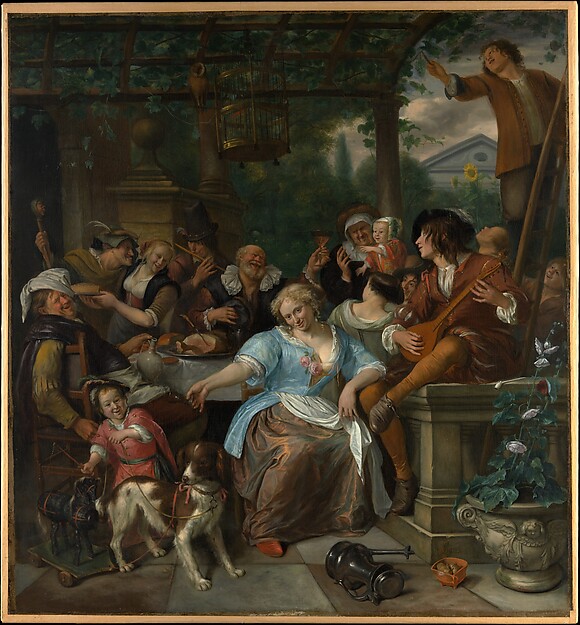
Shown: Merry Company on a Terrace — Jan Steen, ca. 1670 · The Met, public domain
Tudor & Stuart · insult
Coxcomb.
First recorded c. 1529 (as the jester's cap)
Tudor & Stuart · insult
Gorbellied.
First recorded before 1529
Big-bellied, fat, pot-bellied; used as a jeer at well-fed, prosperous people ('gorbellied knaves').
Tudor & Stuart · insult
Poltroon.
First recorded c. 1529
An utter coward; a mean-spirited, spineless wretch. Borrowed from French, from Italian poltrone, 'idler, coward'.
Tudor & Stuart · insult
Mumpsimus.
First recorded 1530
A person who clings to an old error even after it has been pointed out, or the stubbornly repeated error itself. It comes from a joke about a priest who misread the Latin 'sumpsimus' ('we have taken') as 'mumpsimus' and refused to correct it.
Tudor & Stuart · insult
Blockhead.
First recorded 1532
A stupid person, someone with no more brains than a wooden block (the head-shaped block used by hat- and wig-makers). At first it could also mean the wooden head itself.
Tudor & Stuart · insult
Hobbledehoy.
First recorded 1540
A clumsy, gawky youth at the awkward age between boy and man.
Tudor & Stuart · word
Lickpenny.
First recorded by 1556
Something that 'licks up' your pennies — a thing or place that makes money vanish. The classic use is 'London lickpenny': the city that drains a visitor's purse. Later it could also mean a greedy, grasping person (Century Dictionary); Wiktionary also gives 'a miserly person'.
Tudor & Stuart · insult
Mooncalf.
First recorded 1560s
A foolish or absent-minded person. The gentle modern meaning of a word that began, in the 1560s, as a term for a shapeless growth blamed on the moon.
Tudor & Stuart · insult
Curmudgeon.
First recorded 1568
At first a grasping, churlish miser; today a bad-tempered, stubborn person, usually an older man. Its origin is unknown; the old 'coeur méchant' (wicked heart) and 'corn merchant' explanations are rejected.
Tudor & Stuart · insult
Tosspot.
First recorded 1568
A heavy drinker, one who 'tosses off' his pot of ale; a drunkard. In modern British and Irish slang it has become a general insult for a fool.
Tudor & Stuart · oath
by Jove.
First recorded 1575
An exclamation of surprise or emphasis. Originally a real oath by Jove (Jupiter, chief of the Roman gods); it then served as a safe stand-in for 'by God', and became a stock phrase of the Victorian and Edwardian English gentleman.
Tudor & Stuart · insult
Saucebox.
First recorded 1588
A saucy, cheeky, impudent person, someone always ready with a pert remark. Later slang also used it for the mouth.
Tudor & Stuart · insult
Ninnyhammer.
First recorded by 1590
A fool or simpleton; an extended form of 'ninny'. What the '-hammer' adds is unclear (one tentative suggestion is dialect 'hammer', a clumsy person, or to stammer).
Tudor & Stuart · insult
Jobbernowl.
First recorded 1592
A stupid person, a blockhead; also a mocking word for a big, thick, stupid-looking head. Probably from old 'jobard' (a simpleton) plus 'noll' (the head).
Tudor & Stuart · oath
zounds.
First recorded by 1592
An exclamation of anger or surprise. It is a softened (minced) form of the oath 'God's wounds!', referring to the wounds of Christ on the Cross.
Tudor & Stuart · insult
Loggerhead.
First recorded 1595
A thick-headed, stupid person; a blockhead. Probably from dialect 'logger', a heavy block of wood, plus 'head'. Later also a large head, an iron tool, and (from the 1650s) a turtle; 'at loggerheads' (quarrelling) dates from the 1670s.
Tudor & Stuart · oath
'sblood.
First recorded c. 1597
An old oath of anger or astonishment, short for 'God's blood', referring to the blood of Christ. The initial 'S is all that is left of 'God's'.
Tudor & Stuart · insult
Fustilarian.
First recorded c. 1597
A comic insult, apparently a one-off coinage: a fusty, stinking, low fellow. It seems to be built on 'fusty' (musty) or 'fustilugs' (a fat, frowzy person).
Tudor & Stuart · oath
odsbodikins.
First recorded c. 1600 (as “God's bodykins”)
An archaic exclamation of surprise. It is usually explained as softening 'God's body': 'ods' disguises 'God's' and 'bodikins' is a pet form of 'body' (Farmer & Henley: 'God's little body'). A minority view reads 'bodkins' as the nails of the Cross.
Tudor & Stuart · insult
Tatterdemalion.
First recorded c. 1600
A ragged, tattered person; a ragamuffin. The ending is a made-up flourish (early spellings rhyme it with 'Italian'). From the 1610s it is also an adjective, 'ragged, tumbledown'.
Tudor & Stuart · insult
Addlepate.
First recorded 1601
A muddle-headed, foolish person. 'Addle' first meant liquid filth and then a rotten egg that will not hatch, so an addlepate has a head as empty and spoiled as an addled egg.
Tudor & Stuart · insult
Clotpole.
First recorded 1601
A thickhead or blockhead: literally a head ('poll') made of a clod of earth. Shakespeare also uses 'clotpoll' simply for a head.
Tudor & Stuart · insult
Fustilugs.
First recorded by 1604
Shared today as 'a clumsy, slovenly person'. In the old dictionaries it was harsher: a big-boned person, and especially a fat, gross or bad-smelling woman.
Tudor & Stuart · insult
Bedswerver.
First recorded c. 1610
An unfaithful partner. Coined, as far as the record shows, by Shakespeare in The Winter's Tale — for a woman who was innocent.
Tudor & Stuart · insult
Slubberdegullion.
First recorded 1610s
A slobbering, dirty, slovenly fellow; a worthless wretch. Built on 'slubber' (to smear, to do things sloppily) with a fanciful ending, perhaps meant to sound French (the ending's origin is uncertain).
Tudor & Stuart · insult
Jolterhead.
First recorded 1620 (as 'Iolter-head')
A big, heavy head, and so a thick-headed, stupid person; a blockhead. An expanded form of the Tudor insult jolthead.
Tudor & Stuart · insult
Hog-grubber.
First recorded by 1623
A mean, stingy, sneaking person; a close-fisted miser. B.E. (c. 1698) calls one 'a close-fisted, narrow-soul'd sneaking Fellow'.
Tudor & Stuart · insult
Clodpate.
First recorded 1636
A thickhead, a dull, heavy-witted person, often a country bumpkin: a head ('pate') no better than a clod of earth.
Tudor & Stuart · insult
Rapscallion.
First recorded 1648
A rascal, rogue or scoundrel; a worthless, disreputable person. A fanciful stretching of 'rascal' (earlier 'rascallion').
Tudor & Stuart · insult
blatherskite.
First recorded c. 1650
A person who talks a great deal of blustering nonsense; also the nonsense itself. Scottish in origin (blether 'foolish talk' + skate/skite 'contemptible fellow'); the song 'Maggie Lauder' carried it to America, where it became common 19th-century slang for a windbag or good-for-nothing.
Tudor & Stuart · oath
gadzooks.
First recorded mid-1600s
A mild exclamation of surprise or annoyance. It is a condensed, softened oath, usually said to stand for 'God's hooks' (the nails of the Cross); 'Gad' is a common disguise for 'God'.
Tudor & Stuart · word
Gasconade.
First recorded 1652
Boastful talk; bluster or bravado. From French gasconnade, 'talking like a Gascon', because people from Gascony were proverbially boastful. As a verb (from 1727), to brag.
Tudor & Stuart · insult
Rantipole.
First recorded by 1653
A wild, rude, romping young person, boy or girl; as an adjective, wild and unruly. Grose (1785) adds 'a gadabout dissipated woman'. In some older slang it also had bawdy senses (see sensitivity note).
Tudor & Stuart · insult
Fopdoodle.
First recorded 1664
A silly, insignificant fool. A genuinely old and now obsolete insult, built from two older words for a fool.
Tudor & Stuart · insult
Lickspittle.
First recorded 1669
A fawning toady, a base flatterer who will lick up another's spittle to win favour. The image goes back to the older phrase 'lick (someone's) spittle', recorded in the first half of the 1600s.
Tudor & Stuart · oath
egad.
First recorded 1673
A mild exclamation of surprise, emphasis or annoyance. A softened oath whose second part is 'God' (as 'Gad'); the first part is uncertain — perhaps 'ah' or 'oh', or 'I'.
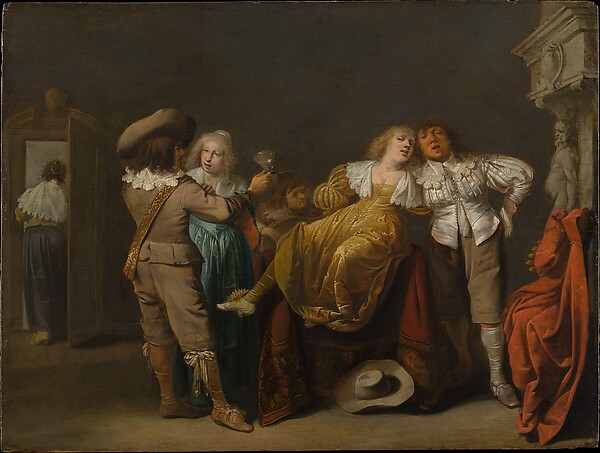
Shown: A Party of Merrymakers — Pieter Jansz. Quast, ca. 1635–38 · The Met, public domain
Tudor & Stuart · insult
Nincompoop.
First recorded 1670s
Tudor & Stuart · insult
Shabbaroon.
First recorded by 1675
A shabby, down-at-heel, badly dressed person; by Grose's time also a mean-spirited person.
Tudor & Stuart · oath
Jiminy.
First recorded 1686 (as “jemminy”)
A mild exclamation of surprise. It developed from the older oath 'Gemini!' and is generally explained as a disguised 'Jesu Domine' or 'Jesus'; the extended 'Jiminy Cricket' (by 1848) is likewise a euphemism for 'Jesus Christ'.
Tudor & Stuart · insult
Grumbletonian.
First recorded c. 1690
A chronic grumbler about the state of the country. It began around 1690 as a Court-party nickname for members of the opposition 'Country party', mocked as place-seekers sulking at the government; it punned on sect names like Muggletonian.
Tudor & Stuart · insult
Numskull.
First recorded 1697
A dull-witted, stupid person; literally a 'numb skull', from num, an old spelling of numb. The main meaning (a stupid person) has not changed; the word has also long been used for the head itself ('a thick or muddled head'), which is the sense in the Fielding example.
Tudor & Stuart · word
Shilly-shally.
First recorded by 1700 (as 'shill I, shall I')
To dither, hesitate or be unable to make up one's mind; a mocking reduplication of 'shall I? shall I?'. Grose gives 'to stand shilly-shally', to hesitate or stand in doubt.
Georgian · insult
Chucklehead.
First recorded by 1731
A blockhead or dolt. 'Chuckle' here has nothing to do with laughing: it is an old word for a clumsy or stupid fellow, perhaps from chuck, 'a lump of wood', so a chucklehead may have a head like a block of wood.
Georgian · insult
Scapegrace.
First recorded by 1732
A reckless, disorderly good-for-nothing, often a mischievous boy; literally one who has 'escaped the grace of God'. Grose defined it as a wild dissolute fellow.
Georgian · word
Humbug.
First recorded by 1751
First a trick, hoax or jest played on someone, and 'to humbug' meant to deceive. By the 1820s it also meant sham, hypocrisy and nonsense in general, and a humbug could be a person who is a fraud. The word's origin is unknown.
Georgian · insult
Gadabout.
First recorded by 1757
A person who goes restlessly from place to place in search of fun, company or gossip. From the verb gad, 'to wander idly'. The older form 'gadder about' goes back to the 1560s.
Georgian · insult
Gollumpus.
First recorded by 1785
A large, clumsy, loutish fellow. It is known almost only from Grose's dictionary and the later editions that copied it.
Georgian · word
Taradiddle.
First recorded by 1788
A fib; a petty lie. Later also pretentious or silly nonsense. Perhaps built on diddle, 'to cheat'.
Georgian · insult
Cockalorum.
First recorded c. 1798 (as a self-important person)
A little man with a big opinion of himself; a self-important boaster. It can also mean boastful talk itself, and 'high cockalorum' is a leapfrog-style game.
Georgian · word
cheese it.
First recorded 1811
Thieves' and street slang for 'stop it! be quiet!' and, as a warning, 'look out — run!'. Its origin is unknown (Partridge guessed a corruption of 'cease').
Georgian · insult
Gobermouch.
First recorded 1818 (as gobemouche)
An Irish word for a busybody — someone who meddles in other people's business. It comes from French gobe-mouche, 'fly-swallower', which in English means someone who believes anything.
Georgian · word
Collywobbles.
First recorded by 1823
A stomach ache or upset stomach ('the gripes'). Later, by extension, a fit of nerves or anxiety. Probably a playful blend of colic and wobble.
Georgian · word
Mollycoddle.
First recorded by 1823
First a noun for a pampered, over-protected man or boy; by about 1839 (Etymonline; Merriam-Webster says 1865) the verb, to over-indulge or pamper someone. From Molly (pet form of Mary) + coddle.
Georgian · oath
crikey.
First recorded 1826
An exclamation of astonishment. Victorian slang dictionaries all explain it as a disguised form of 'Christ!' — Hotten calls it a 'profane exclamation of astonishment'. Today it is mild and especially associated with British and Australian speech.
Georgian · word
Bunkum.
First recorded by 1828
First, speech-making aimed at impressing voters back home rather than persuading anyone ('talking to Buncombe'). By the usual story, a North Carolina congressman, Felix Walker, insisted during the 1820 Missouri debate on speaking 'for Buncombe', his home county. It soon broadened to mean any nonsense or claptrap, and gave us 'bunk' and 'debunk'.
Georgian · word
Hornswoggle.
First recorded 1829
To cheat, trick or swindle someone. American English, first recorded in 1829, and probably made up for the fun of the sound.
Georgian · word
Absquatulate.
First recorded by 1830
To leave in a hurry; to make off or abscond. A jokey mock-Latin American coinage of the 1830s, as if from ab- 'away' + squat + -ulate.
Georgian · insult
cad.
First recorded 1830s
A man who behaves dishonourably, especially towards women; an ill-bred, ungentlemanly fellow. The word began as a shortening of 'cadet'/'caddie' for errand-boys, bus conductors and townsmen (as scorned by Oxford students), and by the 1830s–40s had become a general term of contempt.
Georgian · word
Flapdoodle.
First recorded 1833
Nonsense. Originally, in 1833, 'the stuff they feed fools on' — a word for what fools eat before it became a word for what they say.
Georgian · word
Catawampus.
First recorded by 1834
An American comic word that first meant fierce or utterly (1830s–40s); from the 1860s it came to mean askew, awry or crooked, and later diagonal (like kitty-corner). It could also name an imaginary fierce creature.
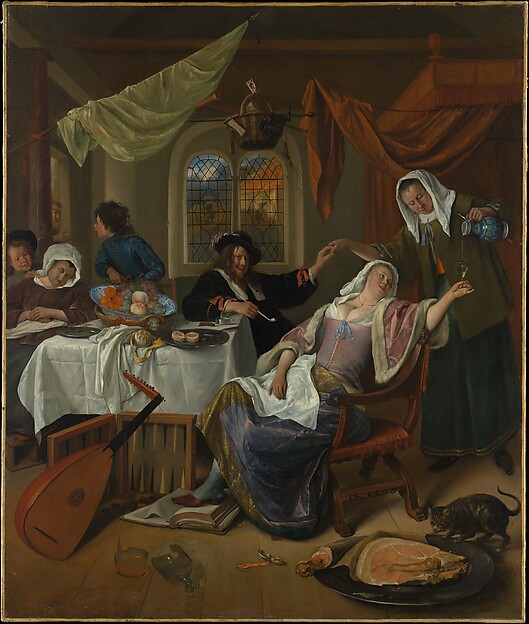
Shown: The Dissolute Household — Jan Steen, ca. 1663–64 · The Met, public domain
Victorian & Edwardian · insult
Scallywag.
First recorded 1839
Victorian & Edwardian · word
bloviate.
First recorded 1845
To talk at length in a pompous, boastful, empty way. A Midwestern American word of the 1840s–50s built on 'blow' on the model of 'deviate'; it faded, then revived in the 1920s around President Warren G. Harding's ornate speeches and again in the 2000s, now mostly of politicians and pundits.
Victorian & Edwardian · oath
Great Scott.
First recorded 1845
An exclamation of surprise or dismay. Its origin is uncertain: it is usually taken as a stand-in for 'Great God!', and 19th-century writers linked it to the famous (and very large) US general Winfield Scott; other theories are unproven.
Victorian & Edwardian · insult
Snollygoster.
First recorded 1845
A clever person with no principles, especially a politician. American slang first recorded in 1845, when it may have meant something else entirely.
Victorian & Edwardian · word
spondulicks.
First recorded 1851
Money, cash. American slang of the 1850s of unknown origin (sometimes said to be from a Greek word for a shell used as money); it faded in the US but survived in British English.
Victorian & Edwardian · word
poppycock.
First recorded 1852
Foolish talk; nonsense. An American word of the 1850s, usually said to come from a Dutch dialect word meaning 'soft dung' (the OED doubts that exact Dutch form, pointing to Dutch poppekak instead); the rude origin was forgotten and it became a genteel way of saying 'rubbish!'.
Shown: A Maid Asleep — Johannes Vermeer, ca. 1656–57 · The Met, public domain
Victorian & Edwardian · word
Lollygag.
First recorded 1859
Victorian & Edwardian · word
Skedaddle.
First recorded 1859
To leave in a hurry; to run away. Popularised as American Civil War slang by the newspapers in the summer of 1861.
Victorian & Edwardian · insult
masher.
First recorded 1872
A dandified man who fancies himself irresistible and forces his attentions on women, especially strangers in public; also, more loosely, a fashionable young man about town. American slang of the 1870s; it was already appearing in British print by 1875 and became a London catchword in the early 1880s.
Victorian & Edwardian · insult
bounder.
First recorded 1875
A man of vulgar or dishonourable behaviour who does not keep to the accepted rules of polite society — often a flashy social climber. Originally British university and society slang; earlier the word also meant a jolting four-wheeled cab.
Victorian & Edwardian · insult
Zounderkite.
First recorded 1876
An idiot — a stupid, blundering person. Shared as Victorian slang from the 1811 Dictionary of the Vulgar Tongue, where it does not appear; it is in fact a Yorkshire dialect word, recorded in 1876.
Victorian & Edwardian · insult
rotter.
First recorded 1879
A thoroughly worthless, objectionable or morally rotten person; a scoundrel. British slang of the late 19th century, built from 'rot' + '-er'.
Victorian & Edwardian · oath
blimey.
First recorded 1883 (as “blimy”)
An exclamation of surprise, disbelief or exasperation. It is a worn-down form of the working-class oath '(God) blind me!'.
Victorian & Edwardian · insult
Mutton shunter.
First recorded 1883
Victorian slang for a policeman — recorded in 1909 as police slang, dated there to 1883.
Victorian & Edwardian · oath
strewth.
First recorded 1883 (as “struth”)
A mild oath expressing surprise or adding emphasis. It is a clipped form of 'God's truth!'. Common in late-Victorian British slang and later strongly associated with Australia.
Victorian & Edwardian · oath
gorblimey.
First recorded 1891
A Cockney exclamation of surprise, anger or emphasis, representing a street pronunciation of 'God blind me!'. Ware called it 'a gutter phrase'.
Victorian & Edwardian · word
mafficking.
First recorded 1900
Wild, rowdy public celebration of a victory. It was coined as a pun on Mafeking, the South African garrison town whose relief on 17 May 1900 set off riotous street celebrations in London; the verb 'to maffick' was back-formed from it.
Victorian & Edwardian · word
gongoozler.
First recorded 1904
An idle, curious onlooker who stands and stares for a long time at anything unusual — originally canal-workers' slang for people who watch the boats from the towpath or a lock. Popularised by L. T. C. Rolt's Narrow Boat (1944).
Shown: A Woman and Two Men in an Arbor — Pieter de Hooch, ca. 1657–58 · The Met, public domain
Victorian & Edwardian · word
Chuckaboo.
First recorded 1909
Shown: Young Man and Woman in an Inn — Frans Hals, 1623 · The Met, public domain
Victorian & Edwardian · insult
Gigglemug.
First recorded 1909
Victorian & Edwardian · insult
Whooperup.
First recorded 1909
A bad, noisy singer. Victorian theatre and entertainment slang, recorded in 1909 in the plural: whooperups.
Younger Than They Look · insult
Dewdropper.
First recorded 1922
A lazy person — in 1920s American slang, a man who dances all night and sleeps all day. Often sold as Victorian, but it is on record from 1922, not the 1800s.
Sources include the first edition of the Oxford English Dictionary, Johnson (1755), Grose (1785 and 1811), Halliwell (1847), Farmer and Henley, Ware (1909) and Green's Dictionary of Slang.
The ages
Eight hundred years of English, from Old English to the Victorian street — and the books that wrote it all down.
before 1100
Medieval
Still Life with a Skull and a Writing Quill — Pieter Claesz, 1628 · The Met, public domain
before 1100
Medieval
Churl
In Old English a 'ceorl' was simply a free man of the lowest rank, a peasant. By 1300 it meant a bondman or a fellow of low birth or rude manners, and today it means a rude, surly or stingy person.
1344
Medieval
Ragamuffin
A scruffy, ragged person, especially a child. In the 1300s it was the name of a demon.
1476
Medieval
The press arrives
William Caxton sets up England's first printing press at Westminster. Spelling starts to settle; the scribes' hand gives way to type.
c. 1529 (as the jester's cap)
Tudor & Stuart
Coxcomb
A vain, conceited man. From the 1570s — named after the cock's-comb cap worn by professional jesters.
c. 1610
Tudor & Stuart
Bedswerver
An unfaithful partner. Coined, as far as the record shows, by Shakespeare in The Winter's Tale — for a woman who was innocent.
1755
Georgian
Johnson's Dictionary
Samuel Johnson publishes A Dictionary of the English Language — one of the old dictionaries the Scriptorium cites.
1785
Georgian
Grose's slang dictionary
Francis Grose's Classical Dictionary of the Vulgar Tongue records the cant, slang and oaths polite dictionaries left out.
1845
Victorian & Edwardian
Snollygoster
A clever person with no principles, especially a politician. American slang first recorded in 1845, when it may have meant something else entirely.
1847
Victorian & Edwardian
Halliwell's archaic words
James Orchard Halliwell's Dictionary of Archaic and Provincial Words, completed in two volumes in 1847 — where many old country words are written down.
1909
Victorian & Edwardian
Ware's Passing English
J. Redding Ware records the street and stage slang of the Victorian era.
The combination is ours; every word in it is real, with its year. Only playful words — no slurs, and nothing once aimed at a disability.
How we check a word
Find the earliest recordThe earliest book, letter or record the dictionaries give for the word — that year is the one on its label. Older uses sometimes turn up later.
Check the historical dictionariesThe first edition of the Oxford English Dictionary; Grose 1785 and 1811; Halliwell 1847; Farmer and Henley; Ware 1909; Green's Dictionary of Slang — alongside Etymonline, Merriam-Webster and Wiktionary.
Two sources for every meaningAt least one of them a period or scholarly dictionary. Every source is listed on the word's page.
If the age is wrong, we say soHowever often a word has been shared as older than it is, it goes in a room of its own, with the record we found and what we searched.
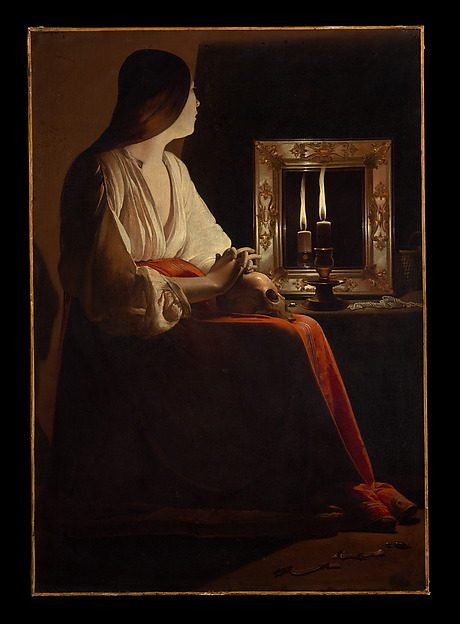
The Penitent Magdalen — Georges de La Tour, ca. 1640 · The Met, public domain
Questions
What is the Scriptorium?
A collection of old English words — insults, oaths and everyday words that fell out of use — each checked against historical dictionaries and dated to the earliest record we could confirm, with its sources listed. It is one of the worlds of 404meanings.
Why isn't everything medieval?
Medieval here means before about 1500, the conventional end of the Middle Ages in England. Most of the words here are first recorded later — 83 of the 104 — so each word hangs in the wing that matches its earliest record: Medieval, Tudor & Stuart, Georgian, or Victorian & Edwardian.
Why do some words hang in a room of their own?
They are real, but younger than they are usually said to be. Dewdropper is shared as Victorian slang, but it is not in Ware (1909), Grose's 1811 dictionary or Halliwell (1847), and the earliest record we found is from 1922. Zounderkite, often listed beside it, turned out to be a Yorkshire dialect word recorded in 1876, so it hangs with the Victorians.
Can I use these words today?
Most of them, playfully. Each word's page says how it was used and whether it has a harsher history — mooncalf, for instance, was once a cruel term for a disability, so it is left out of the insult builder.